Independent strategic advisory for structural change
Re-imagining organisations for what comes next.
S Jegels Consulting works with boards and executives at the intersection of strategy, organisational architecture, AI, technology, capital and human capability, turning complex questions into executable architectures.
Reduce complexity.Make the system visible. Separate signal from noise. Convert competing priorities into coherent choices.
Design for relevance.Challenge which capabilities, roles, processes and business models should still exist in the next operating environment.
Unlock value.Connect strategy, operating design, technology, capital and execution so that transformation produces economic outcomes.
Make it executable.Move from conceptual ambition to architectures, decision rights, roadmaps, controls and measurable transition.
Board-level dialogue and strategic challengeExecutive strategy and decision architectureTransactions, partnerships and aligned interests
Our overarching value proposition
Transformation is a redesign problem.
Technology can accelerate an organisation without improving it. SJC focuses on the deeper question: what should the enterprise become, how should it create value, and what architecture will allow it to operate credibly in the future?
01 · Reduce complexity
See the enterprise as a system.
Strategy, operating model, people, technology, risk, capital and customers are interdependent. We make the relationships explicit so leaders can act on the whole rather than optimise isolated parts.
02 · Re-imagine the organisation
Do not automate what should disappear.
We distinguish between activities worth augmenting, activities worth automating, and structures that should be redesigned altogether.
03 · Navigate the future
Build strategic optionality.
Future-ready design builds the capacity to operate across plausible futures, make reversible choices where appropriate, and commit decisively where advantage requires it.
04 · Transition into AI
Move from use cases to operating architecture.
AI strategy becomes materially useful when it changes how work, decisions, accountability, data, models, agents, controls and human expertise fit together.
05 · Transform & innovate
Change the economics, not only the interface.
New business models, new capital structures, embedded services, intelligent workflows and platform models can create value beyond incremental efficiency.
06 · Executable architecture
Turn ambition into a buildable enterprise.
We translate direction into capabilities, decision rights, workflows, governance, technology architecture, capital logic, implementation priorities and measures of value.
or scroll through the transformation →
The full value architecture
Six lenses. One transformation system.
If you prefer the whole picture at once, the six propositions are brought together here. Each panel retains the same core logic without forcing a full horizontal-scroll journey.
01
Reduce complexity
See the organisation as a connected system and make trade-offs explicit.
02
Re-imagine the organisation
Do not automate structures, roles or activities that should disappear.
03
Navigate the future
Build strategic optionality for uncertainty rather than rely on brittle forecasts.
04
Transition into AI
Move beyond use cases into operating architecture, governance and human accountability.
05
Transform & innovate
Use intelligence, platforms and capital differently to unlock new business models.
06
Executable architecture
Translate ambition into decisions, capabilities, controls, technology and transition.
What are we solving, and what should leaders be asking?
Good advisory begins with the questions that reveal whether the organisation is solving the right problem.
Key questions we answer
One question at a time.
Begin with the strategic question that matters most now, then explore the others as needed.
01 · Strategy
What business are we really in, and what business should we become?
We test the underlying value logic, customer problem, sources of advantage, boundaries of the enterprise and future strategic options.
02 · Relevance
Which parts of the organisation are becoming structurally irrelevant?
We examine capabilities, layers, processes and economics that may no longer justify their current form.
03 · AI
Where should intelligence augment people, where can it act autonomously, and where must humans remain accountable?
The answer determines the operating model, workforce, controls, architecture and governance required.
04 · Trust
What must remain trustworthy when the organisation becomes more automated?
We examine evidence, decision rights, transparency, model governance, cyber resilience, human oversight and institutional legitimacy.
05 · Capital
How should capital, risk and partnerships be orchestrated around the strategy?
Capital structure changes incentives, risk allocation, governance and the feasible growth path.
06 · Execution
Why do transformation programmes produce activity without changing the enterprise?
We identify gaps between ambition and architecture: unclear decision rights, weak interfaces, poor incentives, insufficient capability or ungoverned complexity.
07 · Complexity
How do we manage when there is no single right answer?
Systems thinking, scenarios, decision architecture and controlled experimentation make complexity navigable without reducing it to a false simplicity.
08 · Value
Where is value trapped inside the current organisation?
Value can be trapped in data, under-used capabilities, capital structure, customer relationships, technology, intellectual property or cumbersome process boundaries.
1 / 8
What we do
Capabilities that connect rather than compete.
The work crosses disciplines because the highest-value problems sit between strategy, organisation, technology, capital, risk and execution, across the boundaries of conventional consulting practices.
01
Strategy & enterprise transformation
Strategic options, portfolio choices, transformation theses and value cases.
Click to expand ↓
Corporate and business strategy
Transformation portfolio design
Scenario and strategic option analysis
Value cases and mobilisation roadmaps
02
Operating models & organisational architecture
Capabilities, processes, governance, decision rights and hybrid capacity.
Click to expand ↓
Target operating model design
Capability and process architecture
Decision and governance architecture
Human-AI capacity and organisation design
03
AI strategy & AI-native enterprise design
From AI use cases to a governed organisational and technical architecture.
Click to expand ↓
AI strategy and operating model
Agentic workflow and authority design
AI governance and human accountability
AI-native enterprise architecture
04
Insurance & financial services transformation
Underwriting, claims, actuarial, distribution, capital, reinsurance and platform design.
Click to expand ↓
Insurance 3.0 / Native AI Insurer
Underwriting and claims transformation
Actuarial, finance and reinsurance integration
Insurance operating platform design
05
Enterprise architecture & platform design
Business, data, integration, AI, technology, controls and cybersecurity.
Click to expand ↓
Conceptual and logical enterprise architecture
Decision and information architecture
Platforms, integration and APIs
Security, resilience and control layers
06
Blockchain, tokenisation & digital assets
Enterprise DLT, tokenisation architecture, governance and programmable workflows.
Click to expand ↓
Tokenisation use cases
Smart-contract governance
Digital trust and identity
Regulatory-perimeter and operating-model design
07
Capital orchestration & transaction architecture
Capital stacks, partnerships, DFI/ECA/bank coordination and risk allocation.
Click to expand ↓
Investment and funding readiness
Capital-stack design
Stakeholder orchestration
Transaction workflow and risk allocation
08
Board, executive & deal advisory
Independent challenge, M&A, strategic transactions and executive decision support.
Click to expand ↓
Board and executive advisory
M&A and integration thinking
Operating-model due diligence
Strategic transaction and partnership design
09
Capability building & executive enablement
AI literacy, architecture fluency, strategic articulation and institutional knowledge transfer.
Click to expand ↓
Board and executive AI literacy
Operating-model and architecture capability
Functional learning journeys
Knowledge transfer and workforce transition
AI leadership as a service
Build the AI function before rushing to fill the title.
Many organisations know they need senior AI leadership, but have not yet defined the mandate, authority, interfaces, governance or capability model the role is expected to own. SJC can operate as an interim / outsourced Chief AI & Transformation Officer and AI organisational-design partner while the permanent function is being created.
OUTSOURCED / INTERIM CAIO
Give the board time to design the role properly.
An external CAIO mandate can create breathing room: establish the enterprise AI agenda, define decision rights and governance, structure the portfolio, build the operating model, mobilise early transitions, and prepare the organisation to recruit the right long-term executive rather than simply the most fashionable AI profile.
Clarify what the CAIO owns versus the CEO, CIO/CTO, data, risk, HR and business executives; define board reporting, authority and value measures.
02 · Build the function
Design the AI office, governance forums, architecture authority, agent/model lifecycle, portfolio management, assurance interfaces and operating cadence.
03 · Transition the enterprise
Prioritise AI-enabled workflows and operating-model changes while managing risk, controls, economics, customer impact and workforce consequences.
04 · Design the AI organisation & workforce
Map human-reserved, augmented and autonomous work; identify new roles; protect institutional knowledge; define capability pathways and transition requirements.
05 · Build or source scarce capability
Determine which skills should be recruited, developed internally, sourced through partners or temporarily provided as external capacity.
06 · Recruit and hand over
Help define the permanent role specification, assess candidate fit, prepare the incoming executive and transition governance, architecture and institutional knowledge.
Important distinction: the outsourced CAIO is not a substitute for board accountability, the CIO/CTO, CRO, Chief Actuary, Compliance or Internal Audit. The role is the strategic integrator of AI-enabled enterprise transformation while independent control functions retain their mandates.
SJC at a glance
Experience and intellectual work in context.
The figures below describe the firm's advisory experience and the scope of its research and diagnostic work.
International advisory35+years across strategy, architecture and transformation
Insurance 3.010chapter executive series on the Native AI Insurer
Published research67page research report on the South African consulting industry
Organisational Pulse6hard-edged diagnostic lenses across strategy, AI, control, work, talent and economics
Client outcomes remain confidential unless evidence and permission support public disclosure.
How we work
Architecture before activity.
The method adapts to the problem, but the discipline is consistent: understand the system, diagnose the constraint, design the future state, validate the economics and risks, then mobilise a transition that the organisation can actually execute.
DiagnoseUnderstand the system, friction, value leakage and strategic constraint.
FrameDefine the decision, future scenarios and the questions that matter.
ArchitectDesign capabilities, flows, governance, people, technology and capital together.
ValidateTest economics, risks, controls, feasibility and organisational consequences.
MobilisePrioritise use cases, initiatives, dependencies and transition waves.
Embed capabilityTransfer the thinking so the client can sustain and evolve the architecture.
Diagnose the system.
Find the constraint behind the visible symptoms and establish what must actually change.
Organisational Pulse
Six hard questions before you transform.
The six lenses test whether the organisation has a clear problem definition, an executable AI foundation, trustworthy control, a viable work architecture, access to the people it will need, and an economic case strong enough to justify transformation.
Read the enterprise as a connected architecture, not a collection of isolated initiatives.Test readiness, trust, capability, economics and exposure together.
X
Solve for X
Are we solving the right problem? Clarifies the strategic constraint, value at stake, assumptions, trade-offs and decision rights.
Open diagnostic →
AI
AI Operating Readiness
Can AI actually operate here at enterprise scale? Tests strategy, data, architecture, governance, workflow readiness and change capacity.
Open diagnostic →
T/C
Trust, Control & Accountability
Can stakeholders trust delegated digital authority, and can we prove who or what made a decision? Tests evidence, explainability, oversight, cyber controls, model governance, redress and safe intervention.
Open diagnostic →
H↔AI
Work & Human-AI Architecture
What work should remain human, become augmented, become autonomous, or disappear? Tests work design, authority and knowledge retention.
Open diagnostic →
T+
Talent & Capability Supply
Where will the people for the frontier organisation come from? Tests role demand, internal skill conversion, recruitment scarcity, learning velocity and external capacity.
Open diagnostic →
ROI
AI Economics & Execution Viability
Does the transformation create more value than complexity? Tests cost, productivity, technology economics, implementation capacity, risk-adjusted returns and value realisation.
Open diagnostic →
AI disruption & risk barometer
How exposed is the enterprise to AI-driven disruption?
This is distinct from readiness. Readiness asks whether the organisation can deploy AI. The barometer asks whether AI advances can weaken, displace or threaten the organisation before it adapts, across its business model, customer interface, economics, workforce, technology, cyber posture, data and regulatory legitimacy.
The result is an indicative strategic exposure signal, not a cyber-security certification, actuarial assessment or regulatory opinion.
ContainedWatchMaterialAcute
60/100Material exposure: disruption pressure is meaningful and the organisation should identify the most vulnerable value pools, capabilities and control surfaces.
Insights & intellectual property
Ideas become valuable when they can be operationalised.
SJC develops practical frameworks, architectures and demonstrators around emerging enterprise questions. They make difficult futures concrete enough for leaders to discuss, test and design.
Flagship series · scroll the chapter charts
Insurance 3.0 | The Native AI Insurer
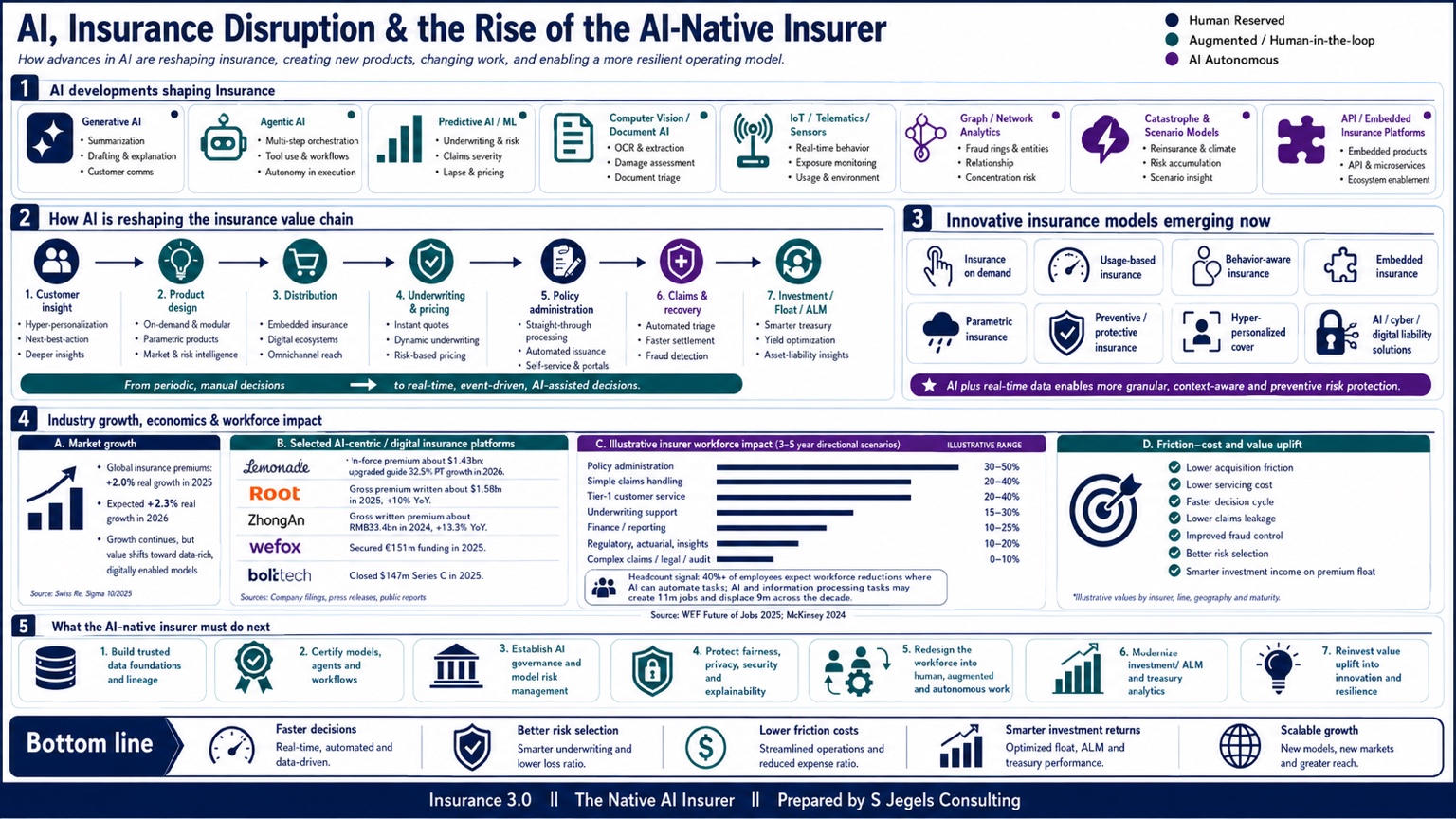
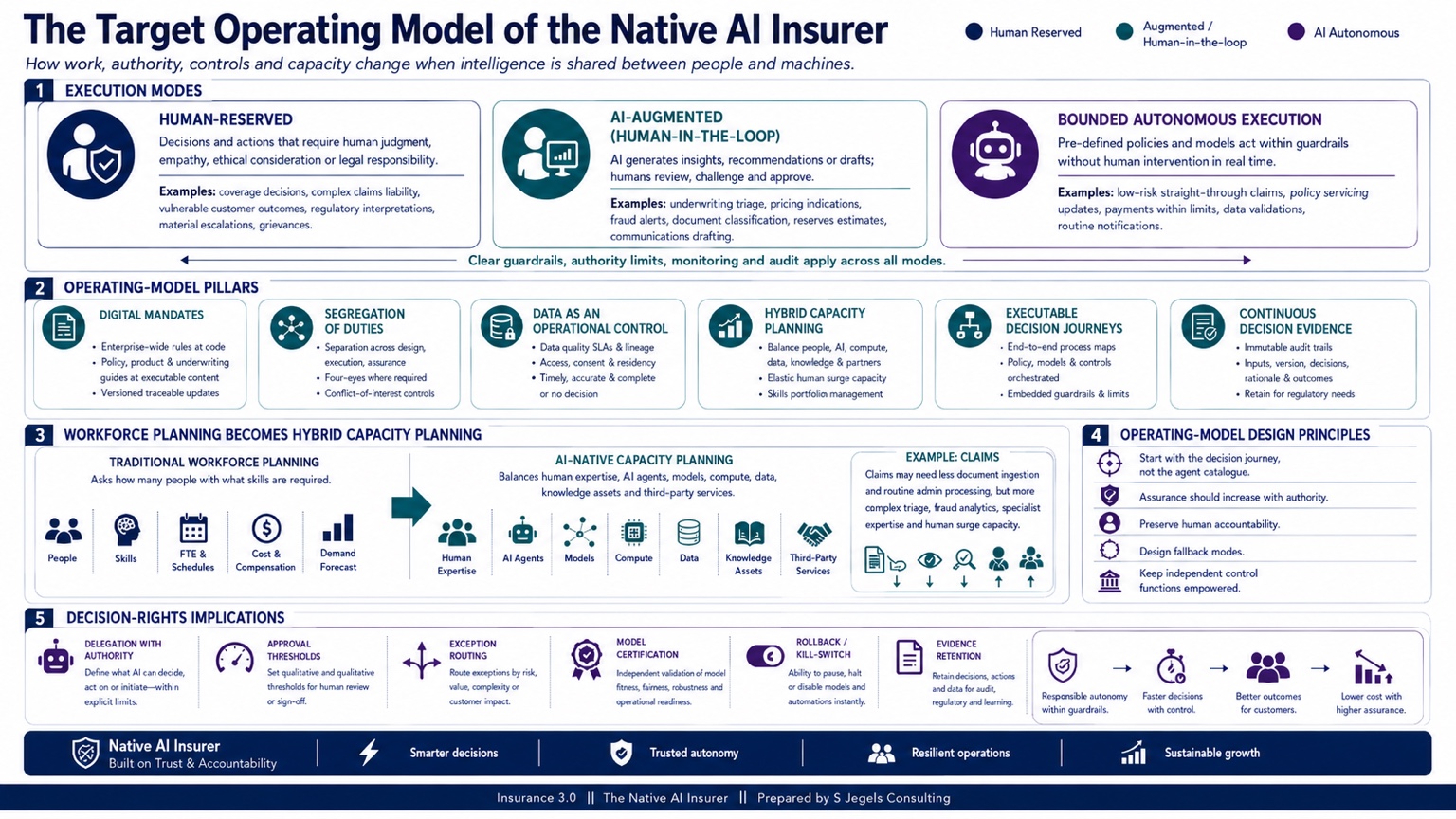
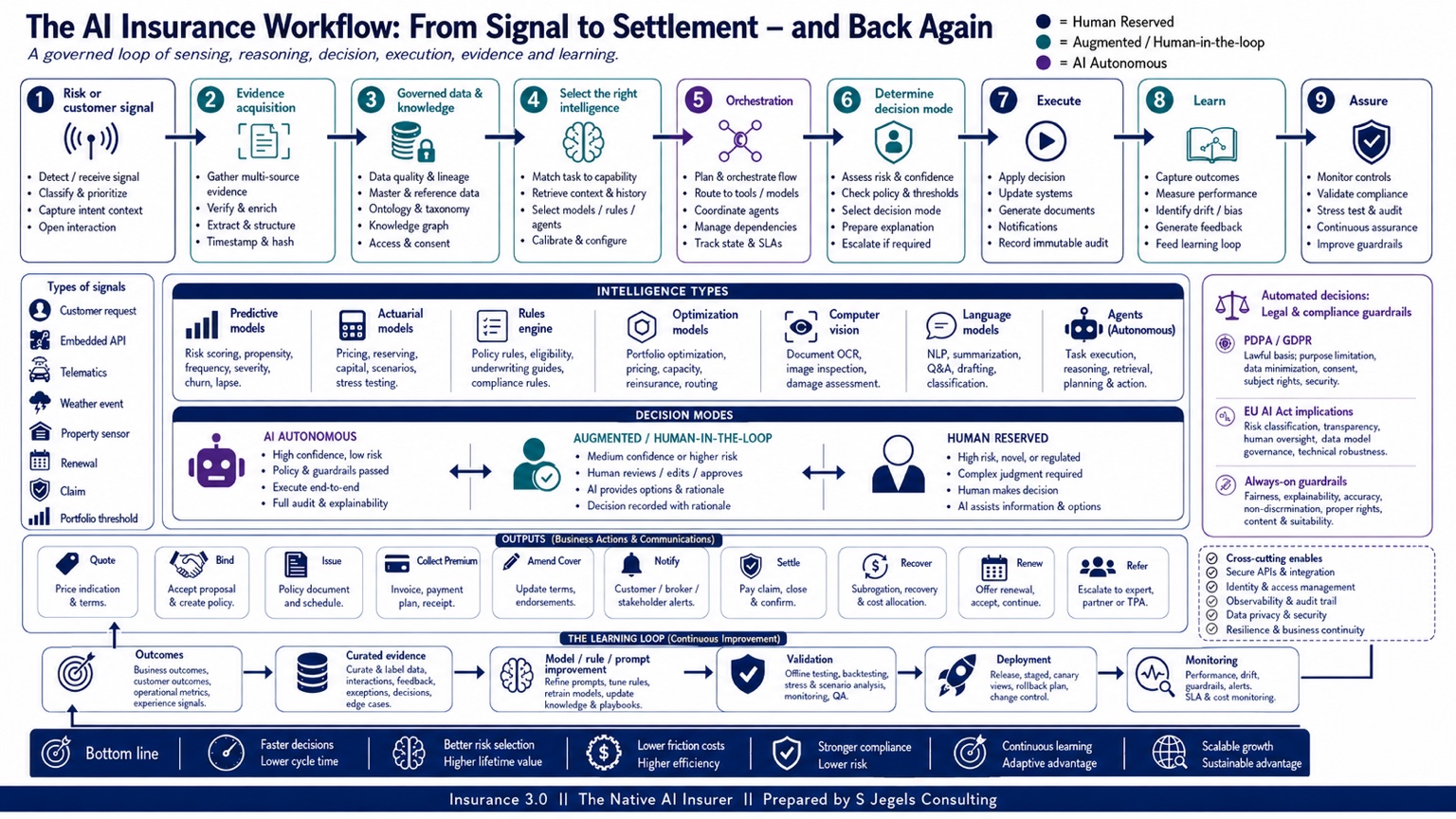
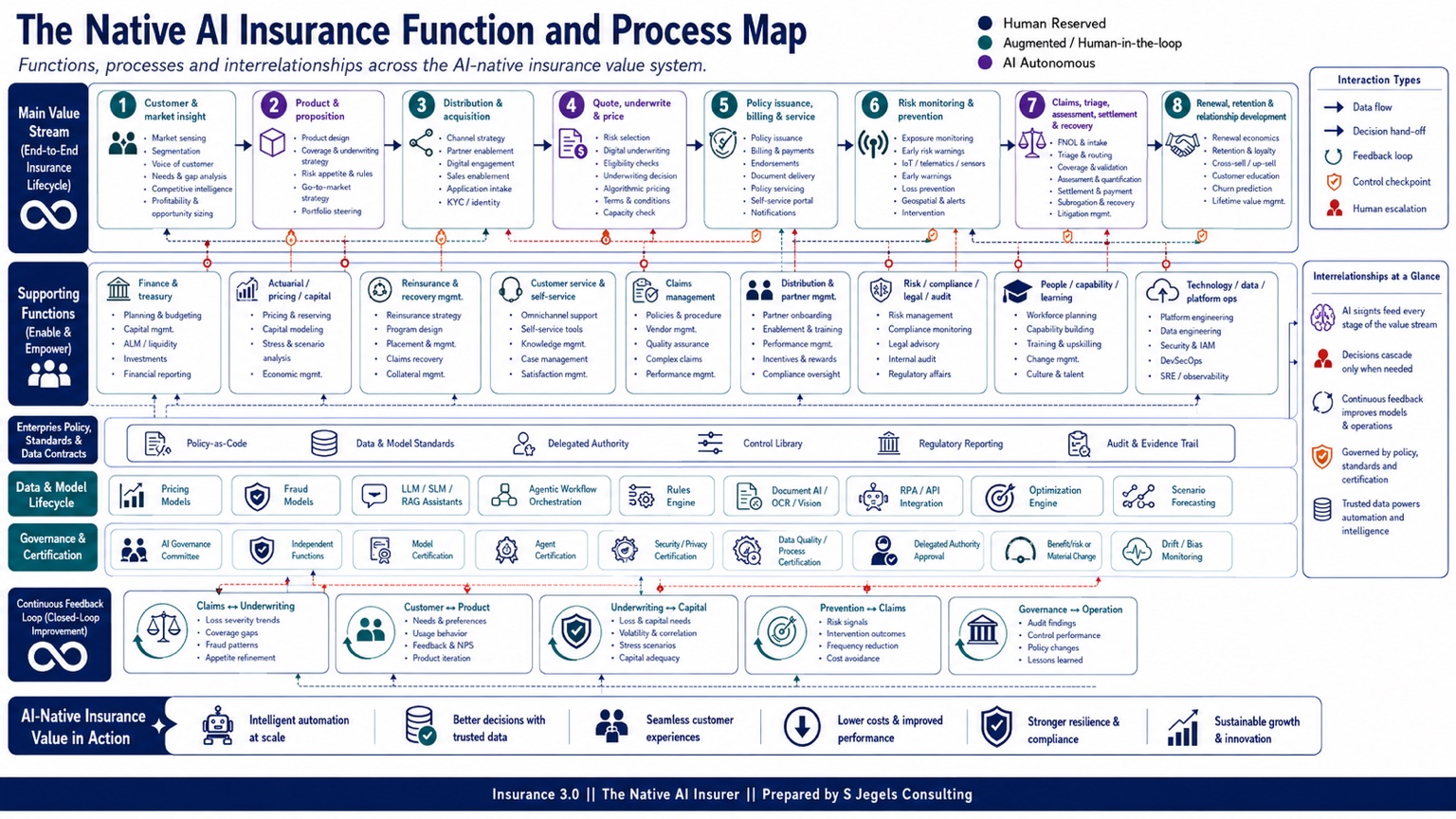
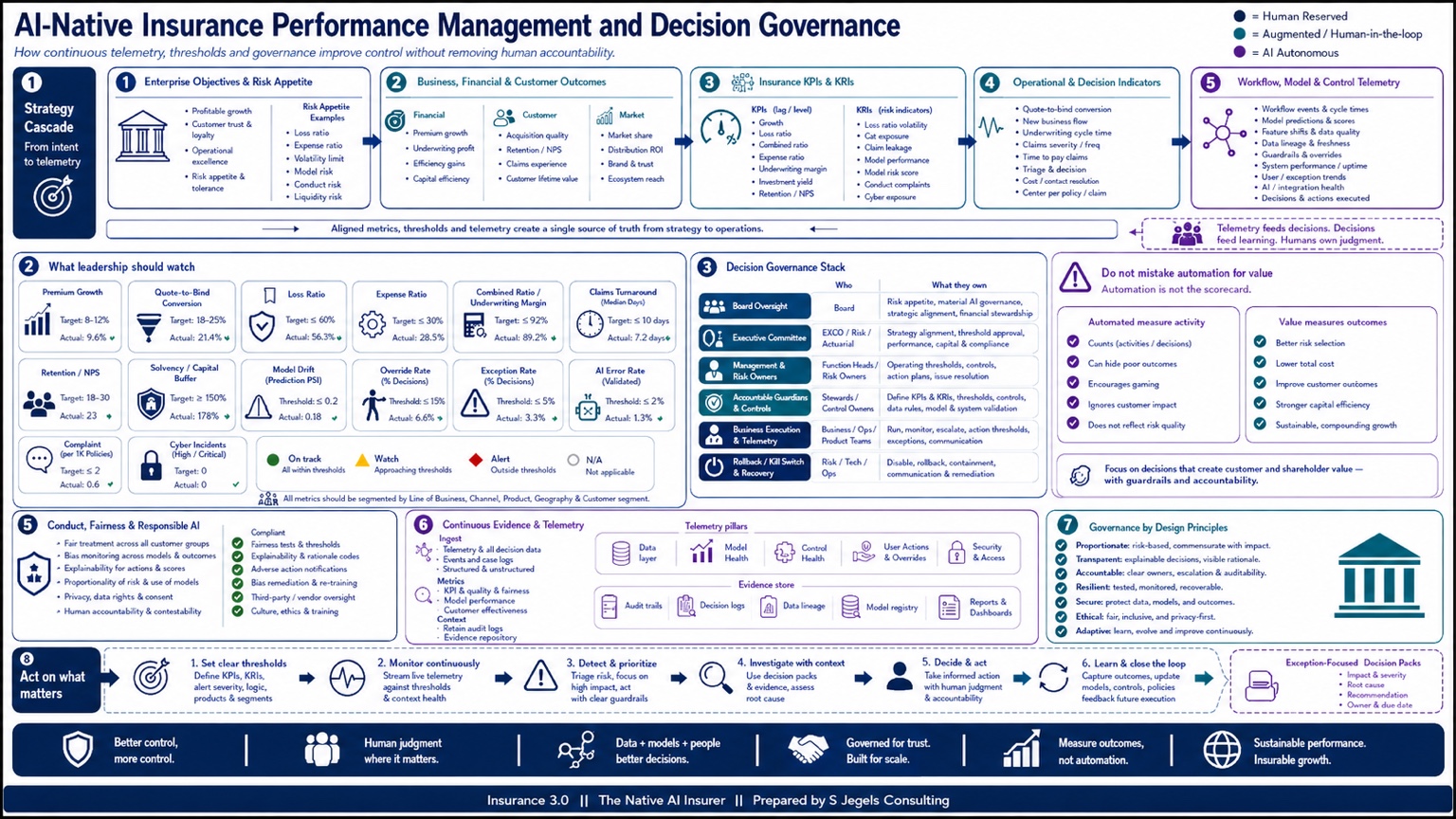
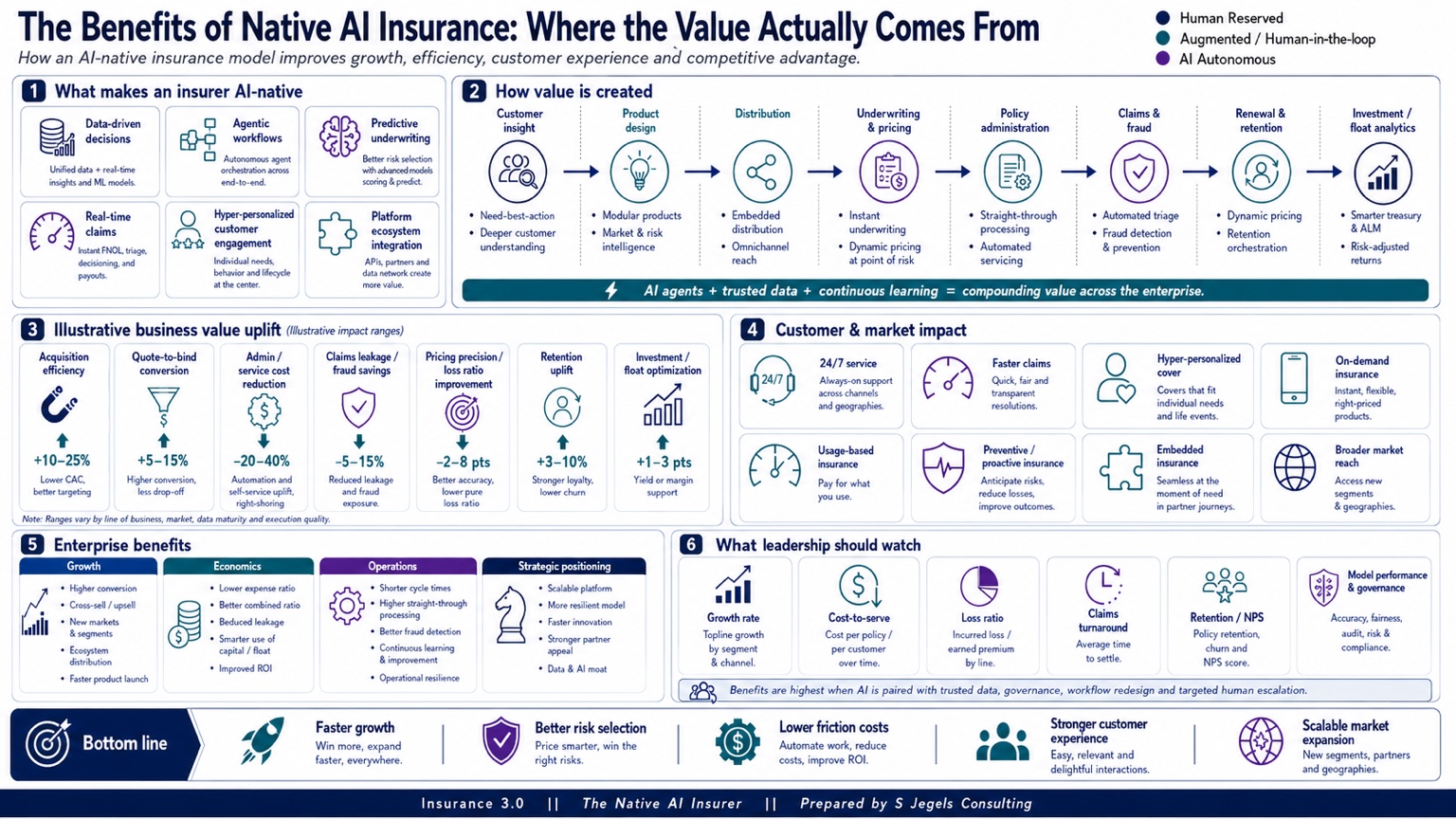
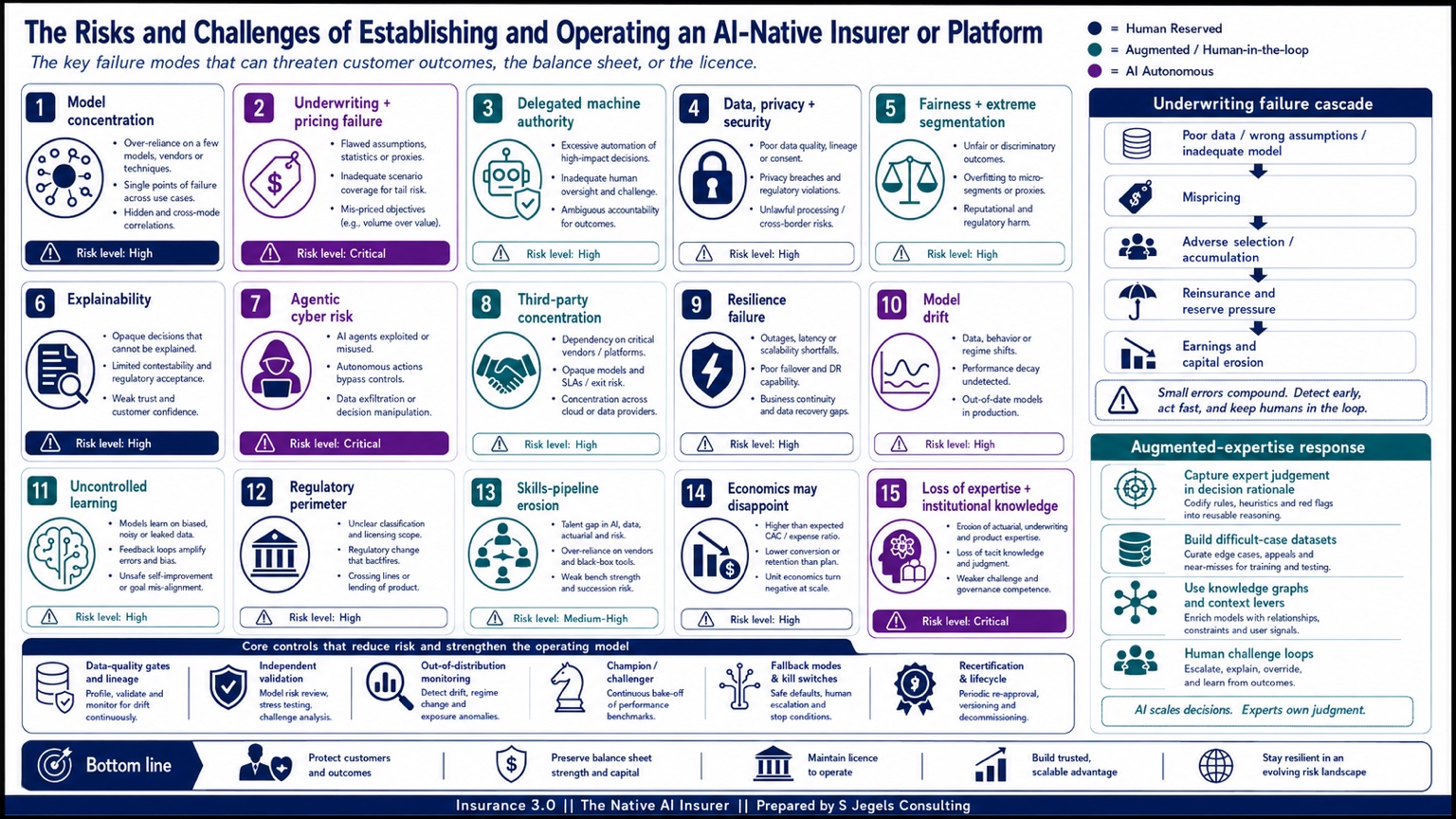
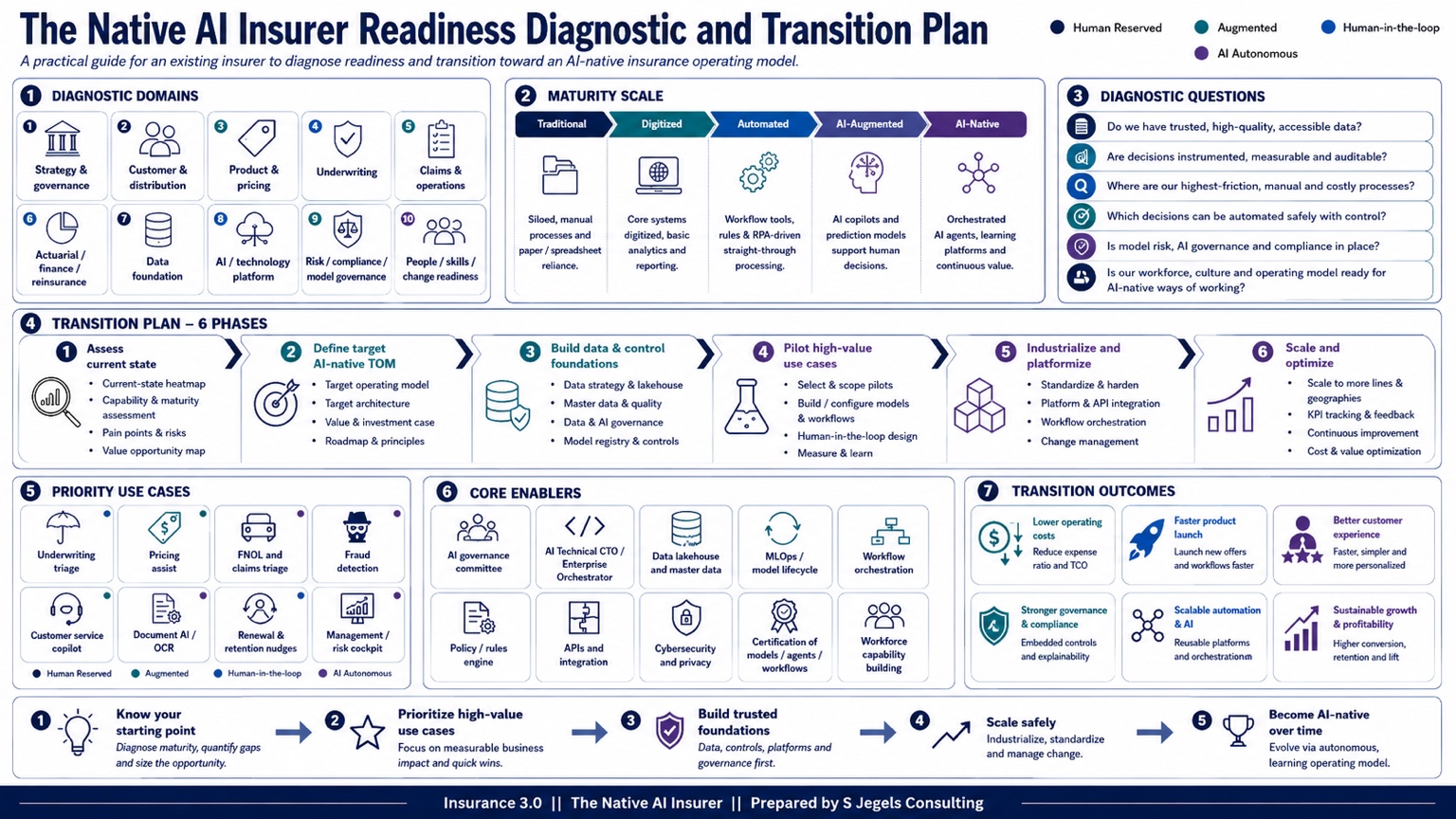
A ten-chapter executive series examining the insurer as a regulated, AI-native enterprise: operating model, workflow, functions, performance governance, value, risk, readiness and human transition.
Chapter 01AI, Insurance Disruption & the Rise of the AI-Native Insurer
Chapter 03The Target Operating Model of the Native AI Insurer
Chapter 04The AI Insurance Workflow: From Signal to Settlement
Chapter 05The Native AI Insurance Function & Process Map
Chapter 08Risks & Challenges of an AI-Native Insurer
Chapter 09Readiness Diagnostic & Transition Plan
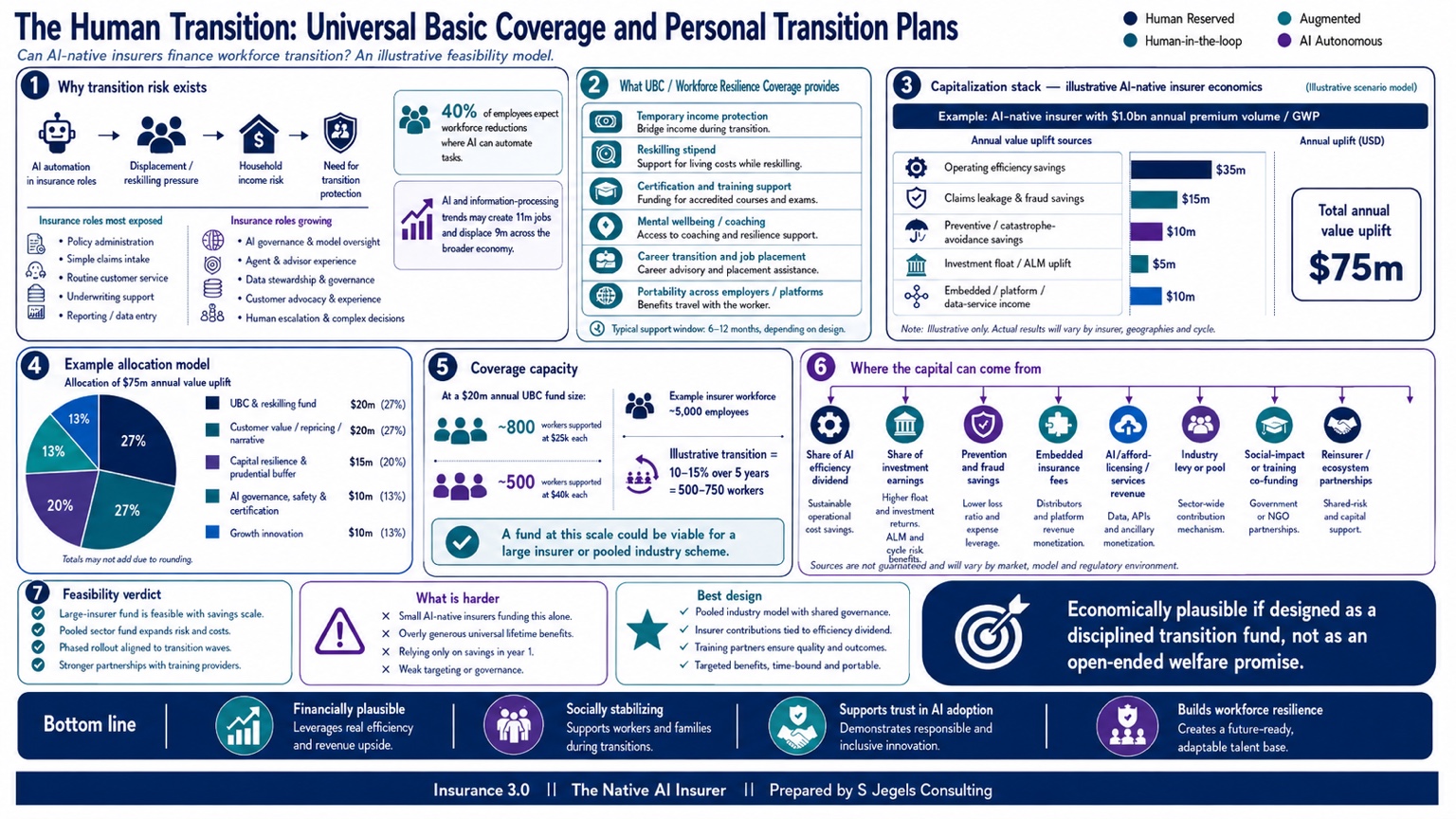
Chapter 10The Human Transition
Enterprise architecture · available on request
⌘
The AI-Native Insurer Enterprise Architecture
The detailed enterprise architecture is intentionally not published in the public gallery. Request it for a qualified advisory, board or platform discussion.
AI for Insurance Handbook A practical and strategic implementation handbook for insurance executives and professionals to implement an AI-centric operating model and conceptual Enterprise Architecture, that will help to apply AI across strategy, the business model, organisation design, functional domains, underwriting, claims, governance, and workflows.
A comprehensive enterprise architecture blueprint for an AI-centric operating model covering governance, business, organisational design, technology, business model, information, and application layers.
Capital & Risk Scenario Intelligence
Conceptual work on capital, risk, scenario modelling and decision support under uncertainty.
Blockchain, Tokenisation & Economic Trust
Enterprise DLT, tokenised participation, transaction architecture and programmable governance concepts as well as a Trust and Human/AI metric system.
M&A Handbook
A practitioner-oriented framework for deal logic, strategic fit, value creation, due diligence, governance, transaction preparation and integration thinking.
Post-Merger Integration Playbook
A structured PMI framework covering Day 1, governance, operating-model integration, synergy capture, culture, systems, capability and value realisation.
South Africa Consulting Industry
67-page research-based proposition for investment purposes, published through Research and Markets in 2022.
S Jegels Consulting works at the intersection of strategy, organisational architecture, technology, AI, capital and transformation, helping complex institutions redesign how they create value, make decisions and operate.
S Jegels Consulting has evolved through more than 35 years of international strategic advisory experience spanning business analysis, enterprise architecture, insurance, strategy, organisational transformation, AI, blockchain, capital structuring, capability building, sustainability and entrepreneurship.
The perspective is cross-functional, shaped through work with executives, boards, actuaries, underwriters, technologists, functional experts, capital providers, public-sector stakeholders and transformation teams across different markets.
The work starts by understanding the system in front of us, then applying proven disciplines to design the architecture that best fits the decision, organisation and context.
35+ years international advisoryEnterprise architectureInsurance transformationM&A transactions & PMI implementationsKeynote speaker - Insurance & AIGlobal capability-building platformsFinTech · EdTech · InsurTech · AgriTechInnovation awardsMBAComputer Science / Mathematics backgroundMIT Sloan executive AI studyOPEX / Six Sigma Black Belt
What is behind the brand?
Four capabilities, connected into one value system.
Vision, enterprise design, trusted technological leverage and empowered transformation combine to create lasting value.
“Leaders need to decide what should remain, what should disappear, what should become intelligent, and what must still be human.”
S Jegels Consulting · Organisational Architecture for the AI era
Start a Conversation
Understanding your Challenge
You do not need a fully formed project brief. A strong advisory conversation can start with the uncertainty itself: what is changing, what is stuck, what is at risk, or what opportunity is not yet structurally possible.
What are you trying to solve?
Typical starting points include strategy, target operating models, AI transformation, Insurance 3.0, enterprise architecture, blockchain/tokenisation, capital orchestration, capability building and strategic transactions.
Initial enquiries are treated as confidential. Do not submit sensitive regulated or customer data through a public web form.
Organisational Pulse
A rapid exploratory diagnostic.
60/ 100 pulse score
Emerging
The organisation has some foundations, but material gaps remain between aspiration and executable architecture.
What is behind the brand?
Strategy · Architecture · AI · Transformation
Four disciplines, combined to create greater enterprise value.
StrategyPurple · Innovation & differentiation
Clarifies the vision, value thesis and choices that create distinctive advantage.
Achieves direction, focus and differentiated growth.ArchitectureGrey · Stability & technology
Turns ambition into coherent capabilities, decision rights, processes, controls and enterprise structure.
Achieves resilience, coherence and an executable design.
AICyan · Trust & security
Applies intelligence, automation and platforms to scale knowledge and decisions safely.
Achieves trusted technological leverage and economies of scale and scope.TransformationGold · Success, reliability & a new dawn
Mobilises people, capital and delivery to turn the designed future into lived organisational change.
Achieves empowerment, adoption and transformation into something greater and more dynamic.
Together, the four elements create a complete value-driving system: strategy sets the vision; architecture gives it design and structure; AI provides trusted technological leverage for economies of scale and scope; and transformation converts intent into change, empowerment and a new dawn. Each discipline strengthens the others. Ambition becomes executable, technology becomes purposeful, and change becomes enduring.